Whose Planet Is It Anyway?

Wednesday, November 25, 2009

The Language of Disability

As an interdisciplinary field of study, Disability Studies explores concepts of disability from many perspectives, seeking to identify social, cultural, historical, political, and economic factors that influence how disability is conceptualized and how people respond to it. This inquiry also involves examining the words and symbols that are commonly used to describe disability, and rhetorical methods are well suited to such an analysis. For those who may be interested in contributing to the discourse in this way, I'm reposting a call for papers addressing the topic of disability and rhetoric:


Call for Papers for a Special Issue of the Disability Studies Quarterly: Disability and Rhetoric

The profound insight of Disability Studies is its conception of disability as a representational system rather than as a medical problem, a deficit, or a personal tragedy (Thomson, 1997). In this view, disability is regarded not as a settled physical or cognitive fact but rather as a discourse, a collection of figures and narratives, tropes and topoi, speakers and audiences that suggest identities and positions in the world to those participating in the discourse. The analysis of disability, then, necessarily goes beyond medical and psychological perspectives to consider how words and other symbols may be used, recalling Kenneth Burke (1969), by human agents, “to form attitudes or to induce actions in other human agents” (41). Disability, to say it another way, is inherently rhetorical and may best be understood through methods of rhetorical inquiry and analysis.

To that end, a special issue of the Disability Studies Quarterly (DSQ) will address the topic of rhetoric and disability. While Disability Studies has revealed the essentially discursive nature of disability, rhetorical theory and analysis promise to further the discussion by contributing a unique set of methods, terms, and concepts. Rhetorical method is a particularly important concern, and we are especially interested in essays that illustrate diverse methods and modes of rhetorical analysis as these relate to disability. Essays may analyze the workings of rhetoric in printed works about disability but also in other media, including film, music, web-texts, graphic novels, and other forms of sound and image.

We define “disability” broadly to include physical, cognitive, and intellectual difference. The ideal essays will enrich understandings of the relationship of rhetoric and disability, but will also serve as models for future scholarship in studies of symbolic representations of disability. Potential issues or topics may include, but are not limited to, the following:


- Disability as, in, or and rhetoric
- Disability and or as trope
- Disability rhetorics in the media
- Disability rhetorics in the classroom, workplace, or home
- Disability rhetorics and narrative
- Disability and digital rhetorics
- Activism and rhetoric
- Disability and audience
- Disability and rhetorical appeals, the rhetorical canons, and/or the rhetorical triangle
- Disability and legal/governmental rhetorics
- Rhetorics of accessibility
- Rhetorical constructions of disabled identity

Timeline
Queries or abstracts sent by February 1, 2010
Full submissions due July 1, 2010
Final revisions due November 31, 2010
Publication in the Winter 2011 issue of DSQ.

Submission guidelines
Manuscripts must be in the form of a Word document and:

- Have a cover page that includes the author's name, institutional affiliation, and contact information
- Have an abstract of 100-150 words
- Be between 3,000-6,000 words in length (approximately 10-20 double-spaced pages)
- Provide full references for all citations
- Include a brief biography of the author (50-100 words)
- Follow DSQ guidelines: http://www.dsq-sds.org/about/submissions#authorGuidelines


Please send queries and submissions to John Duffy (jduffy@nd.edu) and Melanie Yergeau (yergeau.1@osu.edu).

References
Burke, K. (1969). A rhetoric of motives. Berkeley: University of California Press.

Thomson, R. G. (1997). Disability, identity, and representation: An introduction. In R.G. Thomson, Extraordinary Bodies: Figuring Physical Disability in American Culture and Literature. New York: Columbia University Press, 5-18.

Labels: ,

Monday, September 21, 2009

Cultural Symptoms

Over the weekend, I got into a discussion about whether a scientifically based argument could be made to convince researchers and other professionals not to use disease-oriented language like "symptoms" in discussing autism. Although I have seen several articles that take the approach of citing research studies that show autistics to have superior cognitive and perceptual abilities in some respects, and then going on to argue that it does not make sense to describe superior abilities as symptoms, I think that's a dubious approach because identifying superior abilities is not a scientific way of determining whether or not something is a disease or disorder. Rather, it depends on how society values the particular set of abilities being measured, which is based on the cultural expectations of the majority population. If autistics were in the majority, for instance, it's likely that written language would be valued more highly than speech, and being chatty might be labeled a symptom of a disorder.

Ultimately, whether or not something is a disease or disorder isn't a matter of scientific fact, but is instead a social value judgment on the desirability of the characteristics at issue. In the book Unstrange Minds, cultural anthropologist Roy Richard Grinker makes this point quite clearly (page 11) when he states that "autism, like all disorders, does not exist outside of culture. It is culture that sees something as abnormal or wrong, names it, and does something about it..."

Throughout history, diseases have been defined as a matter of popular consensus. Often, as with cancer and influenza, it was based on simply observing that people were dying or in serious pain. In other instances, cultural beliefs led to the popular acceptance of such things as demonic possession and witches' curses. But although modern medical science has studied many conditions in great detail, identifying their particular characteristics to an extent unimaginable in more primitive times, the underlying determination of whether or not something is a disease is no less a cultural one.

So there's really no way to prove by scientific means that autism is, or is not, a disease or disorder. The argument against using language based in the disease model is fundamentally one of ethics: Should a group of people be labeled as disordered if they themselves do not agree with that characterization? This is the same argument made a few decades ago by gay rights activists who successfully argued against the medicalization of homosexuality, and society ought to respond to it in the same way.

Labels: ,

Saturday, July 25, 2009

Context and Consequences

In response to a recent guest post in the New York Times "Motherlode" blog, which used language such as "nightmare" to describe raising an autistic child, blogger Sarah of Cat in a Dog's World wrote an e-mail pointing out that such descriptions were hurtful to autistic people reading them. Her reply was published as a separate article on Motherlode and received numerous comments, some of which suggested that the mother who wrote the original guest post should not be criticized for honestly expressing her feelings and that it was natural for a parent to feel stressed by a child's disability. Sarah then wrote an entry on her blog in which she explained that she was not accusing the mother of intentionally trying to harm the child; rather, she was addressing the broader issue of the impact of such words in a culture that frequently represents the existence of autistic people as a burden and tragedy.

Looking at these posts and comments, I was reminded of a news article I read many years ago about five little Korean girls who attempted suicide because they felt unwanted after a younger brother was born into their family. The sisters overheard their father, on many occasions, talking about how glad he was to finally have a son after so many years of having had only daughters. Believing that their father did not value them as they were, the girls concluded that he would be happier if they were dead.

The reporter did not interview the father for the article, but I would guess that he did not in fact have any ill-will toward his daughters and that he was horrified by what happened. He probably never had any idea that his daughters could feel hurt by his words; after all, wasn't it entirely natural for a father to want a son?

And indeed, many parents want children who are like themselves—whether we are talking about a father who longs for a son, a ballet-loving mother who wishes her athletic daughter were more feminine, or a non-autistic parent who would prefer a highly social child. Having such expectations is not at all unusual, and parents often do find it stressful and confusing when a child turns out to be different from what they had anticipated.

In most such cases, the prevailing cultural expectation is that the parents will quickly put aside their feelings of disappointment and accept the child that they actually have. Descriptions of life with a child who differs from one's expectations as a "nightmare," or similar extreme language, would not as a general rule be considered socially acceptable and would not appear in the mainstream media unless the article had to do with learning to appreciate and value a child's differences. The potential for harm would be immediately recognized.

But as Sarah's blog entry discusses, although modern society has recognized as a general rule the importance of understanding and accommodating diversity, the autistic population often does not get the benefit of the rules that apply to everyone else. Numerous articles have described autistic people in derogatory terms that would never make it into print if applied to any other minority group. The excuse usually given for publishing such articles is that parents naturally feel that way.

It's not a very good excuse.

Labels: , , ,

Friday, May 29, 2009

A Diagnostic Label Is Not an Insult

At best, a label is a means of enabling people to get useful services for their particular needs. Although the system does not always work as it should, at the very least a label ought to be simply a descriptive term, rather than being used as an insult by people who do not have the diagnosis. Unfortunately, we all know that such language is used all the time:

"That was such a retarded thing to do."

"He's so clueless, what is he, autistic or something?"

"You're acting like a total spaz."

Now, I'm fairly sure that most of the people who talk like this are being thoughtless, rather than intentionally hateful. If they had ever considered the possibility that they might be overheard by someone who actually had a diagnosis of Mental Retardation, or Autism, or Spastic Cerebral Palsy, they'd have chosen their words more carefully. But such language is so widespread in our society that millions of people just repeat it without thinking about it.

And then there's what I would call the flip side of using a label as an insult: Taking great offense to any criticism of one's behavior, out of fear that others might suspect that one has Big Bad Behavioral Disorder Cooties. Here are a few examples of that:

"How dare you slander me by saying that I have problems controlling my temper! I'm perfectly sane and nothing at all like Those People who go to anger management counseling!"

"Someone told me I was being passive aggressive in a conversation. I'm extremely insulted by that because there is an official psychiatric category of passive aggressive personality disorder."

"What do you mean, I'm too defensive? Are you suggesting I'm some kind of psycho?"

Once again, I think that in most such cases, it's a matter of thoughtlessness and not outright hate. The person who took such umbrage to the words "passive aggressive" probably never stopped to consider the social implications of insisting so vehemently that she wasn't at all like those with an official diagnosis. I'm sure it never even occurred to her that by equating a diagnostic category—which no one had suggested that she actually belonged in—to an insult, she was adding to the stigma against those who really were diagnosed in that category. That's often the way stigma works; it's like a children's game of Hot Potato, where everyone is so anxious to get it away from themselves that they don't care who ends up with it.

Sometimes, people just need to stop and think before they speak.

Labels:

Tuesday, December 02, 2008

Researchers Identify Autism Biomarker

A study presented at a meeting of the Radiological Society of North America indicates that it may be possible to accurately identify autistic children at a very early age by measuring brain wave patterns to determine if a child has a significant lag in auditory processing. As reported in an Associated Press article:


The brain wave study used noninvasive technology called magnetoencephalography, MEG for short. It measures magnetic fields generated by electrical currents in brain nerve cells, and records brain activity in real time.

Researchers at Children's Hospital of Philadelphia had 64 autistic children ages 6 to 15 listen through headphones to a series of rapid beeps while under the helmet-like device, which recorded the brain's response to the sounds. Those brain waves, shown as highlighted areas on an imaging screen, were compared with responses in a group of non-autistic children.

In autistic children, response to each sound was delayed by one-fiftieth of a second.

"We tend to speak at four syllables per second," said Timothy Roberts, the study's lead author and the hospital's vice chairman of research. If an autistic brain "is slow in processing a change in a syllable ... it could easily get to the point of being overloaded."


Although the study did not include younger children, the researchers believe that it may be possible to use the same method of brain wave measurement for diagnostic purposes in very young children.

The reporter suggested that the benefit of using this biomarker for diagnosis would be that "it could mean behavior treatment much sooner." But as I see it, a diagnostic biomarker would be valuable for precisely the opposite reason—because it would take autism out of the subjective realm of behavioral observations and define the condition, for the first time, in terms of hard science. Autistic children would receive more of the services that they need from speech and language professionals, instead of spending large amounts of time in intensive behavioral programs that lack solid research to support their practices.

Although reasonable people can differ on the issue of whether some autistic children may be helped by behavioral therapies, it is a fact that behavioral practitioners are not trained or licensed to provide speech therapy or related services. If autism is to be defined in terms of auditory processing differences, then I believe the logical conclusion is that services for autistic children should be provided primarily by, or under the direction of, speech and language professionals.

Labels: , ,

Monday, August 11, 2008

Tropic Thunder Boycott Begins

Special Olympics chairman Timothy Shriver has announced that he, along with other disability rights advocates, plans to picket the premiere of Tropic Thunder today in Los Angeles because of its repeated use of the R-word and other offensive language. Mr. Shriver wrote an editorial explaining his reasons for advocating a boycott, in which he describes the movie as "an unchecked assault on the humanity of people with intellectual disabilities—an affront to dignity, hope and respect."

Here's an excerpt from Mr. Shriver's article:


People with intellectual disabilities are routinely abused, neglected, insulted, institutionalized and even killed around the world. Their parents are told to give up, that their children are worthless. Schools turn them away. Doctors refuse to treat them. Employers won't hire them. None of this is funny.

For centuries, they have been the exception to the most basic spiritual principle: that we are each equal in spirit, capable of reflecting the goodness of the divine, carriers of love. But not people with intellectual disabilities. What's a word commonly applied to them? Hopeless.

Let's consider where we are in 2008. Our politics are about overcoming division, our social movements are about ending intolerance, our great philanthropists promote ending poverty and disease among the world's poor. Are people with intellectual disabilities included in the mainstream of these movements? For the most part, no.

Why? Because they're different. Their joy doesn't fit on magazine covers. Their spirituality doesn't come in self-help television. Their kind of wealth doesn't command political attention. (The best of the spirit never does.)

Sadly, they're such an easy target that many people don't realize whom they are making fun of when they use the word "retard." Most people just think it's funny. "Stupid, idiot, moron, retard." Ha, ha, ha.

I know: I could be too sensitive. But I was taught that mean isn't funny. And I've been to institutions where people with intellectual disabilities are tied to beds or lie on concrete floors, forgotten. I've heard doctors say they won't treat them. I know Gallup found that more than 60 percent of Americans don't want a person with an intellectual disability at their child's school.

I've talked to people with intellectual disabilities who cry over being insulted on a bus. I've received too many e-mails from people who are devastated not by their child's disability but by the terror of being laughed at, excluded and economically devastated.

It wasn't funny when Hollywood humiliated African Americans for a generation. It's never funny when good and decent human beings are humiliated. In fact, it is dangerous and disgusting.


Thank you, Mr. Shriver, for making it clear that hate speech of the sort found in Tropic Thunder has very ugly real-life consequences. It's not just harmless humor.

This PSA entitled "R Word," produced by Christschool for the Autistic Self Advocacy Network, shows the impact of such language. Readers, please pass it on by copying or embedding the link into your blog posts.


This is what I have to say to the DreamWorks executives, Ben Stiller, and all the others involved with the production of Tropic Thunder who didn't even notice that there was a problem with their language, apparently because the R-word has been used on occasion in other movies without any consequences. Here's my version of the movie's offensive tagline:

Never go full bigot.

Labels: , ,

Monday, August 04, 2008

Simple Cruelty: Tropic Thunder and the R Word

This post has been edited to delete a link to display a graphic (no longer available), which called for banning the R-word. I generally don't believe in banning offensive words, despite my well-known propensity for behaving like "the word police" in criticizing them. (I'm not offended, Maddy, I know you meant it in a friendly way.)

I do, however, believe that it is both appropriate and socially responsible to point out offensive and harmful uses of language when they occur. As for individuals and commercial entities that intentionally profit from the use of such language, showing no empathy whatsoever toward the people harmed by their cruelty, I believe that boycotting them and their sponsors often can be the most effective way to get their attention and force them to clean up their act.

What do you feel is the best way to deal with situations like this? Patricia E. Bauer is asking this question regarding the movie Tropic Thunder, which is due to be released August 13th and spews the R-word and its assorted stereotypes all over the script for cheap laughs. Several representatives of disability rights organizations will be meeting with studio executives Wednesday to express their concerns.

If you have a moment, please visit her blog to learn more about the controversy and join in the conversation there on what should be done about it.

Labels: ,

Monday, December 17, 2007

The Other Six-Letter N-Word

Some words are considered so offensive in today's society that just using such a word once is enough to brand a person instantly as a crude, ignorant bigot. Quite a few celebrities have wrecked their careers by using a certain six-letter N-word, which I won't mention here because someone probably would post an indignant comment telling me that I really didn't need to say it in order to make my point. And they would be right; we all know what that word is because there's such a strong social consensus about its extreme offensiveness.

Of course, there is good reason for our society's strong condemnation of that word. It reflects a very ugly worldview that brands certain people as genetically inferior and undesirable, denies our common humanity, and arbitrarily divides our species into a privileged caste enjoying all the advantages and a lesser caste that is excluded and stigmatized. It is a truly vile word, deserving of all the opprobrium heaped upon it.

There is another six-letter N-word that has a similar effect of dividing people into different groups, giving more advantages to some folks while stigmatizing others as defective and undesirable. This other word, however, is one that is commonly used in today's society. The ugly attitudes associated with it often go unchallenged. Millions of people are forced to struggle against prejudice and discrimination every day because of these attitudes.

Perhaps you've guessed what word I'm talking about—the word "normal."

Labels: ,

Friday, November 30, 2007

On Metaphor and Culture

Autistic people often are described as having significant deficits in the ability to understand figurative language and symbolic representations. The professional literature and the popular media have characterized autistics as extremely literal-minded, sometimes to the point of being incapable of understanding the most basic metaphors without extensive remedial education. Folk sayings and slang expressions often confuse autistics.

As noted by Bev in a recent post on the Asperger Square 8 blog, however, scripted language is a form of metaphor. Scripted language—that is, the use of phrases borrowed from another setting (such as favorite lines from movies or TV shows) is extremely common among autistics. If you visit an Internet forum in the autistic community, you're likely to find a mix of quotes from Tolkien and Heinlein, lines from Star Wars and Dr Who, computer analogies that encompass everything from the workings of the human brain to simple daily life activities, rebellious lyrics from various anti-establishment musicians, video game references, and much more, all bubbling cheerfully away in a richly creative anarchic stew.

So what's causing the confusion here? Why are autistics likely to have trouble understanding popular sayings, and how did mainstream society go so far wrong in believing that autistics lacked the capacity for abstract thought?

Well, I'd put it like this—to understand a metaphor correctly, one must first understand the culture to which it belongs. Metaphors, and the ability to interpret them, do not exist in a vacuum. Bev's post addresses this point (metaphorically) by linking to a summary of the Star Trek episode Darmok, in which Picard's Enterprise encounters a group of aliens who speak entirely in metaphors taken from the cultural saga of their race. Although the universal translator on the Enterprise can render the literal meaning of their words, no useful communication is possible without knowing the context.

Because speech does not come as easily to autistics as it does to others, we often try to compensate by analyzing words and their possible intended meanings in detail, as Bev also has described. This causes us to see ambiguities in commonly used phrases and, sometimes, to become confused by them.

Many of today's folk sayings have their origins in a pre-industrial society that no longer exists. For example, the phrase "make hay while the sun shines" doesn't mean much of anything unless you first understand that a farmer must cut hay on a clear day, so that it will not get wet and spoil, and that villagers in the past who failed to gather sufficient quantities of hay to feed their livestock over the winter were quite likely to starve.

A non-autistic person who was not in the habit of analyzing the meaning of every sentence would simply file such a saying away in his or her mind, upon first hearing it, as an unfamiliar phrase. He or she probably would not ask what it meant and would not take any action based on it. After hearing it a few more times, in various situations, the person eventually would learn its usage (while still being unaware of its origin) from context.

However, an autistic who heard this phrase for the first time probably would try to reason out the intended meaning and, not being familiar with its history, might reasonably conclude that he or she had just been asked to go to a farm and cut some hay because the work would be pleasant on such a nice sunny day, or something of the sort. Far from reflecting a lack of imagination and analysis, this misunderstanding actually would be a consequence of applying more imagination and analysis than the circumstances required.

On the other side of the cultural/linguistic divide, non-autistics often fail to understand the metaphorical nature of autistics' use of scripted language because they haven't had enough conversations of this kind to learn the context. Autistics are a small minority, and most people, no matter how well-intentioned, just aren't going to talk with us enough to get a good grasp of how we use language. As a result, an ugly stereotype has developed that characterizes autistics as little more than robots or tape recorders, repeating phrases randomly with no intelligent thought.

Cross-cultural communication is always fraught with the potential for misunderstanding, even under the best of circumstances. When the majority group makes the arrogant assumption that it is intellectually superior, that potential increases exponentially. Andrea just posted an excellent list of potential pitfalls in cross-cultural relationships; you may want to take a look at it and think about the implications for a while!

Labels: , ,

Tuesday, June 26, 2007

Patterns and Language

I started to write a response to a post about language on the Ballastexistenz blog, but it got long enough so that I decided to put it here instead. Amanda wrote that she used the phrase "this week" without really meaning to refer to that precise unit of time:


I didn’t mean this week. I meant, this-arbitrary-measurement-of-chunk-of-time-longer-than-a-day.

I could’ve said, the past few weeks, this month, the past few days, last month… those are all phrases in my repertoire for that kind of thing, and they pop out interchangeably.

This is, I suppose, one of the hazards of using and learning language by pattern. Especially when I’m tired, I’ll know which phrases “sound right” together, and “go right” together, but it’s really, really easy to forget to check them against what I’m actually meaning. So “some kind of chunk of time” simply becomes substituted with any chunk of time. A particular topic area gets substituted with its opposite without noticing, because both are connected in some way in the pattern system in my head.

And my speech seems irreparably that way, patterns devoid of internal meaning for the most part, or only tangentially tied to it.


Describing time can indeed be difficult for those of us who don't naturally sort it into exact linear segments in memory. Like Amanda, I've often talked about something that happened "last week" and then realized that it was two weeks ago, or three weeks.

I wouldn't describe that as a pattern fault, though. It's more that the language isn't precisely matched to the intended meaning because of shortcomings in the language itself. We all (autistic or otherwise) have to map our personal experiences onto a language that can be very lacking in precision, depending on what we are talking about.

Supposedly, the native peoples of northern Canada have hundreds of words for snow in their languages. I don't know if that's actually true or if it's just an Internet legend, but it does illustrate how experiences shape the development of language. If visual-spatial thinkers were in the majority, we might have a very different language, with specific words for things like "a chunk of time, somewhat recent, more than a day ago."

But we don't, so we just have to get our meaning across as best we can with the available words, just as if we came from a tribe that perceived different kinds of snow—we'd have to struggle to find words to describe them effectively in English.

To put it another way, being unable to find precise words to describe something, and using some other phrase as a substitute, doesn't necessarily mean that there is a defect in, or damage to, the brain's speech-generating circuitry. It also doesn't necessarily mean that patterns or scripts are being used without understanding. Sometimes there just isn't an adequate word in the language to describe a particular object or idea, and it might not be practical or feasible to take the time to pause and search one's brain for a precise set of words to approximate the intended meaning as nearly as possible, because there is too much else going on in real time.

I don't believe that this happens only to autistics. I think it's more likely that everyone is at a loss for words sometimes, just because of the inherent limitations of words, but because our prevailing cultural scripts and the commonly used words in our language are more closely matched to the experiences of the majority, the pop-culture scripting that's often done by non-autistics (such as using sports metaphors or chattering about something that a celebrity did) is seen as normal.

Labels: ,

Wednesday, March 28, 2007

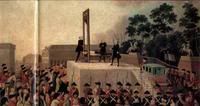
An Execution for a Dysfunction


Place de la Révolution, 1793


I had a few ideas for blog posts last week, but I never did get them written because I couldn't focus well, the words didn't flow, I kept getting distracted, and I felt out of sorts generally.

Just another unfortunate autistic person struggling with the hardships of executive dysfunction?

Well, no, actually... it was (with apologies to any male readers who may think this is too much information) PMS, which got me feeling so cranky that I didn't dare try to blog, lest my readers conclude that my net nickname was all too well deserved.

That left me contemplating the large number of autistics and other neuro-atypical folks out there who seem to have developed a new fad, in the past few years, of blaming every lapse of attention and failure to complete a task on "executive dysfunction."

They're starting to sound just like the people of a certain age who, every time they misplace their car keys, declare that they must be having "a senior moment." It makes me wonder: Why would anyone choose to go through life with such a negative self-image?

And of course, it's not just their own personal image that suffers when they go around using terms like "disorder," "deficit," and "dysfunction" in reference to the natural workings of their brain. These words and the corresponding mental images soon become firmly fixed in society's impressions of the group as a whole. The stereotypes become pervasive and all-encompassing: Old folks are senile and useless. Better not hire an autistic because he's so dysfunctional that he'll never get any work done. Et cetera.

So why are any of us using such language?

I think it's similar to how women talk about the woes of PMS; they're looking for a bit of understanding and commiseration for what is, in fact, a very real cause of distraction and other assorted issues. But there's a major difference: Women, at least in modern industrialized societies, are assumed to be capable of holding responsible jobs and meeting production expectations, despite the occasional difficulties caused by PMS. With autistics, the prevailing assumptions run the other way.

To be clear, I'm not arguing that there is no factual basis for what the psychologists have labeled as executive dysfunction (which technically refers, not to the broad characteristics of distractibility or procrastination as it has come to be popularly used, but to a significant lag between the cognitive processes of deciding to do something and actually doing it—many thanks to Shan of Facing the Morning for suggesting that it would be useful to edit this post to clarify the proper definition). It is indeed true that many autistic folks take a long time to mentally "shift gears" from one task to another. We walk into a room, stop for a moment and wonder what we're doing there, look out the window at the pretty dandelions, ponder the life cycle of the bumblebee that just landed on one of the dandelions, and only then do we move on to the task we were supposed to be doing.

But I am disputing—and very strongly—the notion that this particular neurological configuration is a defect or dysfunction. I often make interesting serendipitous discoveries or have useful thoughts while I'm "supposed to be" doing something else. Historically, major advances in science and technology have sprung from fortuitous moments of distraction. Archimedes, while daydreaming in his bathtub, suddenly realized that the displacement of water could be used to measure an object's weight. When an apple fell on Newton's head, he got distracted by it and stopped to ponder gravitational equations, rather than just going back to whatever else he was supposed to be doing at the time.

To put it another way, although some of us take a long time to get back to our work after becoming distracted, this is a natural cognitive variation and is not inherently a problem, in and of itself. Although it's often seen as a problem, I'd say that most of our difficulties are the result of a mismatch between our natural free-flowing thought processes and the overly demanding structure of modern society, which expects every minute of our days to be planned and optimized. The fault is in these unrealistic expectations, not in ourselves.

So let's have some more self-respect—and send all those insulting terms with "dys" and "dis" prefixes off to Madame Guillotine.

Labels:

Friday, December 15, 2006

Investigating Refrigerator Mother

I attended a presentation yesterday that had to do with social services in my community. A person from the child protective agency was handing out a document about investigations of abuse and neglect. It contained a checklist for how to spot physical and behavioral signs of possible abuse. In the middle of the list of behavioral indicators, which included such things as showing fear of parents and suggesting that other children should be punished harshly, there was this:

"May appear autistic."

After blinking incredulously at that a couple of times and confirming that it did indeed say what it looked like it said, I went up and explained to this person that "autistic" didn't belong in a list of child abuse symptoms because autism is not in any way caused by abuse.

She replied that it had to do with the appearance of abused children, who sometimes do not talk and can be mistaken for autistic children.

So I told her if that was the intended point, then the list ought to say, "May not talk," or something similar, and that it was not at all appropriate to use a neurological condition as a shorthand description of something else.

After a moment of reflection, she said that she understood what I was saying and that she would change the document on her computer when she got back to her office.

There's an awful lot of ignorance out there, but hopefully my little corner of the world is now a bit safer for families with autistic children.

Labels:

Saturday, December 09, 2006

High Functioning Is an Insult, Too

Neurodiversity advocates often write about why it is insulting to use the term "low functioning" to describe an autistic person who does not speak fluently or who needs some assistance with daily activities. These characteristics do not necessarily reflect a person's overall intelligence or ability, and they certainly shouldn't be treated as a measure of a person's intrinsic worth. When "low functioning" is used on a blog or forum in the autistic community, someone usually will object to it.

The use of "high functioning" doesn't seem to draw as much objection in the autistic community, however. And frankly, I don't know why, because it's just as insulting.

Autism Diva just wrote a post that contains this excellent quote from an article by Professor Morton Ann Gernsbacher on bias in psychological science:

Maggio (1991) recommends that we test our writing for bias by substituting our own group for the group we are discussing. If we feel offended, then our writing is biased. I recommend that we test our interpretations for bias by peeling off the labels, as I’ve done here. If our interpretations make little sense, then our science is biased.

I'm going to apply both of these bias tests to the use of the term "high functioning" to describe autistics who have certain abilities or accomplishments. I'll start by substituting other groups:

"She is a high functioning woman; unlike most women, she can live independently."

"He is high functioning for a black man; he can keep a job."

I'd say this passes the offensiveness test. (To clarify, I don't mean to imply that there is necessarily anything wrong with people who have assisted living arrangements or who do not have a job, but I'm pretty sure that any minority group would be offended if someone were to suggest that this was the natural and inevitable condition of most of the group's members.)

Now I'll peel off the autism label and see whether we're left with anything that makes sense:

"He is a high functioning person."

Hmmm... what does that mean? Is he well educated? Rich? Popular? Imaginative? Healthy? Friendly? Intelligent? Optimistic? Hardworking? Full of kindness and charity toward all? Your guess is as good as mine.

This is what I have to say to those in our community who have been calling themselves "high functioning" autistics: Wise up. That phrase is not the least bit complimentary. All it does is reinforce ugly autism stereotypes. It's roughly the equivalent of saying "I'm smart for a woman" or "I'm successful for a (whatever your ethnic group is)." And what's more, it gives society a free pass to go on denying equal opportunity to autistics because it implies that your success didn't have anything to do with struggling to overcome unfair obstacles—no, it's just because you're naturally high functioning.

Don't be fooled.

Labels:

Friday, September 22, 2006

Neutral Words Glossary

The use of medicalized language to describe autism is an issue that often comes up on the neurodiversity blogs. Several people have written that they would prefer to avoid such language, but they sometimes feel stuck with it because they can't think of a good way to work around it while they are writing a post.

So, at the risk of making myself look like the Hub's arbiter of political correctness, I've decided to put together a list of common medical terms used in relation to autism and some alternatives to them. I hope they will be useful. Please feel free to comment and to suggest additional terms; I'll be updating this list.


Abnormality

Rare trait

Difference
Variation
Outside the average range


Co-morbidities

Co-occurring conditions
Co-existing conditions

Concomitant with autism


Diagnosis

Identification
Classification
Categorization

Assessment
Discovery


Disorder (or deficit or disease)

Condition
Difference
Variation
Diversity


Improvement (when used to describe less autistic behavior)

Adapting to cultural expectations

Developing different skills


Intervention (or Early Intervention)

Education
Teaching
Early childhood program


Normal or healthy (when used as opposite of autistic)

Non-autistic

Average (as to a particular characteristic)
Neurological majority population
Neurotypical (although I don't like this one, it's better than "normal")


Pathological findings

Documentation of differences
Assessment of characteristics


"Red flags"

Indicators
Signs
Common autistic behaviors in early childhood


Risk factor

Possible contributing factor
Factor that increases the probability


Severely autistic (or low functioning)

Non-speaking autistic
Autistic person with self-care difficulties
(by the way, one does not necessarily imply the other)


Symptoms

Characteristics
Traits
Common autistic behaviors


Therapy

Activity (see Joel's essay)
Practice
Learning


Labels:

Saturday, August 05, 2006

The Autism Spectrum and the Great Glass Elevator

Some folks have the idea that an autistic person moves up the spectrum when he or she speaks more fluently, displays less autistic mannerisms, acquires a new skill, develops more social relationships, or in the case of an autistic adult, finds a job or gets married. This linear view of autistic existence seems to envision a process similar to the classic children's story by Roald Dahl, in which success is achieved by smashing through the ceiling of autism in the great glass elevator of therapy (of one sort or another), and the occupant of the elevator, having now become socially acceptable, is miraculously transported to the wondrous heavens of normality.

To quote a crotchety Texas judge by the name of Tom Gray: "There are so many problems (with this opinion) that I do not know where to begin; so I will start where I first knew there was a problem and proceed with a stream of consciousness as new problems emerged."

I'll start with a question: Did you ever try to follow a rainbow, when you were a child, to find out if it really had a pot of gold at the end? You ran across the wet grass, and when you reached the place where you thought the end of the rainbow ought to be, all you could see was a faint shimmer of color in the tiny drops of water at the tips of the grass blades. In the same way, the autism spectrum contains all the bright colors and vibrant hues of our human existence, but it has no end, no clear line of demarcation from the rest of the world.

All children develop new skills and learn more about their social environment as they grow older. (Adults also continue to learn, if they maintain an open mind and a willingness to explore new viewpoints and experiences.) This doesn't make a child or adult less autistic, just better educated and more mature.

And contrary to the another-brick-in-the-wall mindset of our cookie cutter educational system, we don't all have to learn exactly the same things and develop in exactly the same way. Just because a child does not begin speaking at the age listed on a developmental chart, it doesn't mean that he or she will never be able to communicate, and it has no relevance whatsoever to other abilities or to intelligence in general.

The same can be said of harmless behavioral differences such as rocking and hand-flapping. They have no bearing on competence or intelligence, and the only reason why they are seen as undesirable is social prejudice. When an autistic adult finds a job or gets married, that doesn't mean he is any higher on the autism spectrum; rather, it means those around him are higher on the tolerance spectrum.

One more stream-of-consciousness problem: When hierarchical language such as "moving up" is used in connection with autism, it has a patronizing air of social superiority to it, similar to the attitude of wealthy white folks who praise a successful non-white person for becoming educated and moving up out of the ghetto. Yes, education and financial success and social integration are all good things—but the ghetto never should have existed in the first place.

The autistic spectrum is not linear, not an elevator, no more of a constraint than any other way of being. It is a rich and complex part of the bright, beautiful, multidimensional kaleidoscope of human diversity.

Labels: ,

Sunday, July 30, 2006

My Publicist Ate My Homework

I recently wrote a post about a news story which, after describing new research by Dr. Manuel Casanova on the structure of the autistic brain, informed its audience that the research would be used for "wiping out autism entirely." I wrote about how disgusted I was that anyone would use this sort of language.

Dr. Casanova has since posted on both the Autism Vox blog and the Aspies for Freedom forum, asserting that he was misquoted. He wrote:

"I never said that I was getting ready to wipe out autism. The attribution should go to the reporter. I never said most of the statements in that release, they came from the publicist who was there with me. "

He has maintained a polite and respectful tone in his discussion with autistic activists who questioned him about the interview, and I'm amenable to giving him the benefit of the doubt as to his intentions. Still, this debacle goes to show that anyone who is doing research on autism, or who is marketing products or services to the autistic community, needs to be very careful about how their work is presented. It's not enough just to hand the task off to a publicist who knows nothing about the autistic community. Anyone who employs a publicist to write a press release about a new discovery or product related to autism has the responsibility, first, to ensure that the publicist is reasonably well informed, and second, to review the press release before it is given to the media.

One person who commented on Dr. Casanova's posts on Aspies for Freedom pointed out that the autistic community has "become rather paranoid of late." I would describe that as a major understatement. The autistic community is in a desperate struggle for survival. We know that there really are influential, well-financed organizations spreading hate and prejudice against autistics—organizations that would like nothing better than to see every autistic person wiped out. We know that if the eugenicists had their way, the entire global autistic population, recently estimated at 70 million, would go the way of Down Syndrome—deemed categorically unfit to live, reduced to a few isolated survivors treated as subhuman curiosities, always facing the stares and whispers of strangers: "Didn't her mother know there was a prenatal test?"

So when we see a news story about someone proposing to wipe out autism, many of us take it at face value and respond accordingly. Anyone who wants to sell autism-related products or services had better be aware that using careless language with even the slightest whiff of eugenics could turn out to be a major marketing disaster. To the autism industry: Do your homework.

Labels:

Monday, July 17, 2006

Cleanup Needed in Aisle Two

A couple of recent news stories are bouncing around in my head at the moment. The first is a British study showing the prevalence of autism to be about 1 in 86. If this number is accurate on a global scale, it would mean that the world's autistic population is about 70 million.

The second story is about a neuroscientist at the University of Louisville, by the name of Manuel Casanova, who is claiming to have made a breakthrough discovery resulting in an incredible new treatment for autism (yeah right, how many times have we heard that one?) I don't give active links to crap like that, but you can find the full article at wave3.com/Global/story.asp?S=5146301 if you're feeling inclined to read something incredible, in the literal sense of the word. Here's an excerpt that begins by describing autistic brain structure:

More cells and smaller cells, making up tiny brain strands, or minicolumns. These minicolumns take in information, process it and respond to it.

But the increased amount of cells works to increase other abilities -- like mathematics.

Armed with this knowledge, Dr. Casanova is ready to begin working on wiping out autism entirely. "Knowing the pathology, what is wrong with the brains of autistic individuals, opens the door to potential strategies that may actually even lead to a cure."

Dr. Casanova's first step: developing a brain stimulator to bulk-up the brain strands. And he feels so strongly about the potential that he's ready to pay for it with his own money.


Yes, that's the actual wording. "Wiping out." As if 70 million human beings were some sort of noxious infestation. Hey, let's drop a nucular bomb on them thar minicolumns, Bubba. Red-blooded normal folks don't need no wimpy mathematicians doin' no fancy figgerin' nohow.

I'm not actually worried that the next generation of autistics might get their brain architecture restructured into gleaming normality with the amazing handy-dandy brain stimulator. My common sense quack-o-meter tells me it's about as much of a cure for autism as horse manure. What's got me pissed off is that more helpless autistic children are going to be victims of yet another quack cure, zapped with the latest Frankensteinian device as if their brains were no more valuable than those of lab rats. More parents will be fleeced out of their savings with bogus science and phony promises. And more news articles will describe autistic people as vermin to be exterminated.

You want to do some brain wiping, Dr. Manuel Casanova? This is what I have for you: A virtual mop and bucket to clean up the grimy residue of your humanity, along with some virtual disinfectant to wipe out your genocidal bigotry.


Edit, July 19, 2006: Dr. Casanova has left a comment on the Autism Vox blog concerning this story, in which he asserts that he was misquoted (but doesn't actually deny making the "wiping out" statement). Whether or not he said it, my main point stands: Altering the natural structure of millions of children's brains—to make them conform to the expectations of a society that values football players more than mathematicians—is a despicable goal.

Second edit, July 30, 2006: Dr. Casanova also posted on Aspies for Freedom and wrote that he never said he was getting ready to wipe out autism. I've written more about that in a new post, My Publicist Ate My Homework.

Labels: , ,

Tuesday, July 04, 2006

Munchausen by Society

The term Munchausen by Proxy, which was named for the wildly imaginative 18th century storyteller Baron Munchausen, refers to the behavior of a parent who seeks attention by falsely claiming that his or her child is seriously ill. I read about a case like that in my local newspaper. A mother claimed that her young daughter was dying of brain cancer; in fact, the child was completely healthy. To carry off this deception, the mother shaved her daughter's head and gave the child sleeping pills to create a drowsy and sick appearance, telling her that it was medicine for her disease. She even took the child for counseling about her impending death. Neighbors took up a collection to help pay the little girl's medical expenses, and the mother spent the money on clothes and lottery tickets. Fortunately this woman was caught and sent to prison before any permanent physical harm was done to her daughter, but I shudder to think of the extent of the emotional damage. That poor little girl had her childhood stolen from her in the cruelest of ways.

Back when Asperger's Syndrome (which was added to the DSM-IV in 1994) was a relatively new and little-known diagnosis, several parents in the UK were wrongly accused of Munchausen by Proxy when they asked for school accommodations for their Aspie kids. Distraught after receiving the diagnosis, these parents talked about their children in the alarmist terms commonly found in today's accounts of autism, calling them tragic sufferers with a severe mental disorder who probably would never be able to marry, hold a job, or live independently. Local educators looked at the children and saw healthy, intelligent kids with a few nervous habits and quirky behaviors. They reported the parents to social services investigators as suspected Munchausen cases, concluding that there could be no other reason to use such exaggerated negative language.

The parents got help from autism experts, including Simon Baron-Cohen of Cambridge University, who spoke in their defense. The accusations were dropped, and rightly so, as the parents were only repeating the dire predictions that they had heard from psychologists or read on the Internet. The parents were not seeking attention and were not intentionally misrepresenting their kids' condition.

Those educators had a point, though. The apocalyptic language that is often used to describe autistic children reeks to high heaven of Munchausen. The only difference is that the parents, for the most part, are not to blame. Rather, the perpetrators of this colossal fraud are self-aggrandizing psychologists, charitable fundraising campaigns, medical researchers looking for grants, politicians scheming to get votes, and lying hucksters peddling bogus cures.

And just like the girl who was falsely told she was dying of brain cancer, our kids are going to have to deal with the emotional consequences for the rest of their lives.

Labels:

Wednesday, May 03, 2006

My Autism Is Not a Hemorrhoid

The international autistic community will be celebrating Autistic Pride Day on June 18th. That's what the event is called, Autistic Pride Day, in the same way that any minority group would put its name first when expressing pride in its identity and demanding recognition and respect from society.

Excuuuuse us if we're being politically incorrect by not calling this event "a day for people with an unmentionable abnormality to whisper about it." Or perhaps "a day for people who have autism, but who would never dream of being defined by it, to wish that nobody would talk about it because it's just too embarrassing to mention."

This rant about person-first language is brought to you by the letter H and a blog entry entitled My Husband the Hemorrhoid, which I came across while I was browsing through the many posts written for Blogging Against Disablism Day. In this particular entry, the author writes about how annoyed she felt when a mother said that her son "is ADD" while introducing him:

When did it become acceptable to introduce our children by their physical and/or mental capabilities? When did it become the norm to define our children by a condition? I can't think of any moment in a polite and civilized society where we would treat another adult this way.

"Hi, I'd like you to meet my friend Betty. She's a toe fungus!" Blech.


The author goes on to proclaim that a child's diagnosis is nobody's business—that it is personal information and that a parent is showing "disrespect" for the child by mentioning it to others. The post concludes with this statement:

...the next time a (mother) introduces me to her child and says "He's ADD/Autistic/Mentally Retarded", etc, I'm going to shake her hand.

Then I'm going to turn to my much beloved and beleaguered spouse and say, "I'd like you to meet my husband. He's a hemorrhoid."

I mean you've got to make a stand somewhere.


I'm sure this blogger (who identifies herself as a mother of a child who "has autism") wrote that post with the best of intentions. I'm sure she genuinely believes that it's more respectful to stay quiet, to keep all abnormalities forever tucked away behind a tightly shut closet door, and to lump neurological differences into the same embarrassing and unmentionable category as toe fungus and hemorrhoids, than it is to talk about them in a matter-of-fact way.

But she is wrong. The whole concept of using person-first language to gloss over what the majority regards as shameful and undesirable traits is wrong. Our society is never going to overcome its prejudices as long as we awkwardly dance around the fact that we have fundamental and lifelong differences.

My autism is not a hemorrhoid. It is an intrinsic part of my identity, like my gender, my nationality, and my hair color. Actually, it's much more a part of my identity than my hair color, which can be changed in an hour at the beauty salon. So why is it that some people think it's perfectly fine to describe me as a brunette, but "disrespectful" to describe me as an autistic? Presumably it's because they consider my hair color (even if it comes out of a bottle) to be a normal attribute, whereas they view my autism as a tragic misfortune that cannot be politely mentioned.

Using person-first language is the semantic equivalent of averting one's eyes when somebody comes into the room in a wheelchair or on crutches. It reflects prejudice, awkwardness, discomfort, and a negative value judgment.

Autism experts Tony Attwood and Carol Gray have written an article called The Discovery of "Aspie" Criteria, in which they discuss how the diagnostic criteria could be worded in positive terms and also make this observation:

In referring to people with respect to their talents or abilities, politically correct "people first" terminology is not required; labels like musician, artist, or poet are welcomed and considered complimentary.

In the world that I want to live in, it would be just as acceptable and unremarkable for a mother to say that her child is autistic as it would be for her to say that the child is a gymnast, a dog lover, or a stamp collector. And the person to whom the child is introduced would just smile and say, "Nice to meet you."

Labels:

Monday, April 24, 2006

A Devastating Cliche

One thing I've noticed about blogging, and about writing in general, is how very easy it is to use lazy clichés instead of giving one's words thoughtful consideration. Bloggers do it sometimes. Students do it in their writing assignments. Even professional journalists do it, despite their well-intentioned efforts to avoid it.

Often it's harmless and funny, as in this list of journalistic clichés. Every once in a while it gets nasty, such as when racial stereotypes find their way into crime stories. But usually it's not devastating—unless the subject happens to be autism.

Why is the word "devastating" so often used to describe autism in news stories and fundraising materials? How did it become an essential part of what Estée Klar-Wolfond calls The Economy of Pity? Well, to start with, a devastating epidemic attracts a lot more attention and donations than a natural genetic variation.

And wherever there's hype about a tragic incurable disorder, you can be sure that a mangy horde of quack cure peddlers must be very close by, adding their yips and yelps to the din of the calamity howlers.

That's where the well-intentioned but careless journalists come in. They blithely lap up the calamity howlers' sensational press releases and reflexively churn out tear-jerking tales of devastated parents struggling to cope with their afflicted children. And the result of such a media onslaught can indeed be devastating to families, as one mother describes:

"The day after I 'accepted' Ben's diagnosis...I grew to hate him, in some ways. Everything that I saw as indicative of his 'autistic tendencies' I attempted to rid him of by superior intellect. I'm not kidding when I say the day before I loved everything about this little buddha. The day of, it's like I went on a religious crusade."

After seeing so many stories of tragedy and despair, some parents begin to respond to interviews about their child's diagnosis by saying that they are "devastated," simply because the word has become so closely associated with autism in the popular consciousness that it's the first word that comes to mind. Other parents see these interviews and react in the same way, and the ugly cycle continues.

It's a classic example of mass hysteria.

Now let's put all this talk of devastating genetic disease in its proper perspective. I recently watched a TV show about a tattoo artist. One of the artist's clients asked her to put a tattoo of his baby girl on his shoulder. The baby had Tay-Sachs disease and was not expected to live much longer. The father wanted her picture on a tattoo so that he would have something to remember her by.

That's devastating.

Labels: ,